
The Judgement of Paris revolutionized the world of wine…
Forty-seven years ago this May – May 24, 1976 to be exact – the winners were declared at the Judgment of Paris and the world of winemaking changed forever. For that was the moment that American winemakers set the wine world on its head by winning both categories at this prestigious competition!
But what was The Judgement of Paris and how did change the wine world? Today I give you a little Wine 101 history lesson.
The Original ‘Judgment of Paris’
Before this momentous occasion in wine history, the term ‘Judgment of Paris’ was likely to bring a different kind of history to mind. According to Greek mythology, Prince Paris of Troy was asked by the god Zeus to judge which of the Greek goddesses Aphrodite, Hera and Athena was the fairest.
According to the legend, each of the goddesses offered Paris a bribe. He accepted Aphrodite’s bribe of marriage to “… the most beautiful of all mortal women.” Unfortunately, that woman was Helen of Sparta and she was already married.
Paris’ abduction of her lead to the Trojan War and the fall of Troy. Now we know her as Helen of Troy, and she and the infamous Trojan Horse are all most of us remember of Troy. Fortunately, the city of Paris has fared a bit better after its judgment.
The Modern Judgment of Paris
This Judgment of Paris came about because of British-born Steven Spurrier, who we lost in early 2021. His story has been told a multiple occasions, most notably in the wine movie, Bottle Shock. But, let me retell it here for our Wine 101 history lesson… In his early days, Spurrier ran a wine shop in Paris that was frequently visited by winemakers from the Napa Valley, looking to market their wares. After tasting some of their wines, he realized that they deserved to be more widely known and appreciated. As he says…
“I was an Englishman in Paris, I was already a square peg in a round hole. And these were very, very good wines. So why don’t we do something about it?”
His colleague, American-bred Patricia Gallagher, suggested holding a tasting of California wines to celebrate the upcoming bicentennial of the American Revolution. Spurrier quickly agreed and began making the arrangements. First, Gallagher would scout the Napa wineries in 1975 in search of the best America had to offer. Spurrier would return with her notes the following year to make the final selections.
He settled upon six Cabernet Sauvignons and six Pinot Chardonnays from California’s Napa Valley. Far from being the well-known winemaking region it is today, at the time most Americans didn’t know the area produced wine. Back then, the most popular wines in America were fortified dessert wines which cost much less than the expensive ($6 or more!) wines coming from the Valley just an hour north of San Francisco.
French Wine Ruled the World
As former TIME magazine reporter George Taber described the wine world at that time: “The French bamboozled the world into thinking that only in France could you make great wines, that only in France did you have the perfect climate, the perfect earth, the perfect grapes. France was on a pedestal. France was alone.”
Preparing for the Challenge
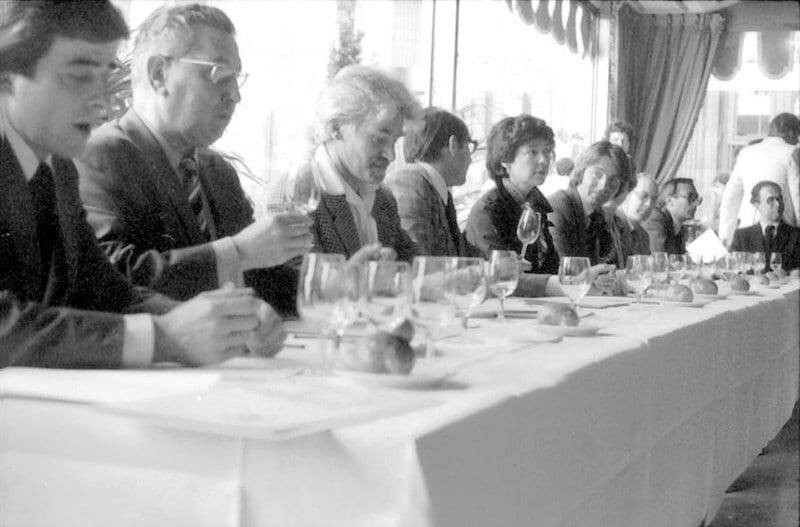
Spurrier arranged an afternoon’s use of a room at the prestigious Intercontinental Hotel. He invited a distinguished panel of judges drawn from France’s most respected gastronomic and wine experts. The nine judges included sommeliers from some of the best restaurants in Paris, the head of a famous French vineyard, and the editor of the influential magazine The French Wine Review, Odette Kahn.
He also invited reporters to the event. The date (May 24, 1976) was reserved, the stage was set, the panel of judges ready. Now bring on the American wines!
Raising the Stakes
According to Spurrier, to the French, “California wine did not exist.” To ensure that the distinguished French judges gave the proper respect to the upstart American wines, he changed the format just two weeks before the event. It would no longer be a simple tasting of American wines.
Instead, the American wines would go head-to-head against some of France’s finest wines from Bordeaux and Burgundy in a blind taste test. Now, the game was on and history was about to be made!
The Story That Almost Wasn’t
Although Spurrier had invited journalists from all over the world to attend the event, his invitations were largely ignored. After all, the results were a foregone conclusion… Weren’t they? Only George Taber, a TIME magazine correspondent in Paris, bothered to show up at the event and then only as a favor to the event’s organizers after they sent him a second invitation.
As Taber said later,
Everybody turned [the invitation] down. I turned it down the first time. Everybody knows that French wines are going to win, so why waste a day? It’s the giant and the little guy. Nobody took it seriously.
George Taber
Because he was the only journalist at the event, Taber had unprecedented access. Also he, unlike the judges, had a list of the wines and the order in which they were being served.
There were six California Chardonnays competing against four French white burgundies and four Bordeaux Grands Crus Chateaux reds up against six California Cabernet Sauvignons.
It must have been hard for him not to laugh whe he heard comments from the judges such as “Ah, back to France!” after sipping a Napa Chardonnay ’72 and “That is definitely California. It has no nose,” about a French Batard Montrachet ’73.
After comments like that, he began to appreciate the possibilities of a real story emerging from the event.
The Wines in The Judgement of Paris
French Red Wines
1970 Château Mouton-Rothschild
1970 Château Haut Brion
1970 Château Montrose, Saint-Estèphe
1971 Château Léoville-Las-Cases, Saint-Julien
French White Wines
1973 Meursault-Charmes
1973 Beaune Clos des Mouches
1973 Bâtard-Montrachet
1972 Puligny-Montrachet Les Pucelles
US Red Wines
1973 Stag’s Leap Cabernet Sauvignon
1971 Ridge Vineyards Monte Bello
1970 Heitz Wine Cellars Martha’s Vineyard
1972 Clos Du Val Winery
1971 Mayacamas Vineyards
1969 Freemark Abbey Winery
US White Wines
1973 Chateau Montelena Chardonnay
1974 Chalone Vineyard
1973 Spring Mountain Vineyard
1972 Freemark Abbey Winery
1972 Veedercrest Vineyards
1973 David Bruce Winery
The Judging
Judging began with the whites. The judges swirled their glasses, then sniffed, sipped and spat, sure in their conviction that they could tell superb French wines from impudent American upstarts.
Imagine their horror when the results were announced — they had given the top score to a California white rather than to one of their beloved French white burgundies!
That’s right, Chateau Montelena’s ’73 Chardonnay won. This small, boutique vineyard in Calistoga, California had beaten the best in France.
(The winemaker of the winning wine as Mike Grgich who later founded Grgich Hills Estate Winery in Napa Valley.)On to the Reds
This time the judges were determined to pick a French wine as the winner. In fact, one American red that was easily discernable as non-French received a punitive score of just two points out of 20. Taber described the treatment of it as if it were “…worse than battery acid or something.”
Unfortunately for the French, they again chose an American wine as the winner amongst the reds. This time it was a Cabernet from Stag’s Leap Winery near Yountville in the Napa Valley.
The American Response
The Judgment might have shaken the world of French winemaking to its core, but American winemakers weren’t quite sure how to respond. Jim Barrett was the general manager and part-owner of Chateau Montelena, the maker of the winning white. When Taber called to get his response, Barrett wasn’t even aware his wine had won! His response?
“Not bad, for kids from the sticks.”
Jim Barrett
Although Mike Grgich made the winning red, he said he didn’t even know his wine was competing until after the fact. He certainly didn’t understand how much it mattered until he got a call from the New York Times asking to photograph him. Then he was so excited, he started dancing around the winery and singing in Croatian, his native language.
The occasion was so momentous that the Smithsonian Institution honored the event by including the Cabernet bottle, along with Alexander Graham Bell’s telephone and Meriwether Lewis’ compass, as part of its ‘101 Objects That Made America‘ exhibit. In fact, each of the two winning bottles now reside within its hallowed halls.
The Judgment Felt Around the World
To gain the proper perspective on just how important that pivotal moment in wine history was, let’s consider what happened almost immediately afterward. The shocking win shattered the myth that great wine was only available from France. Now everyone wanted to try their hand at making world-class wines.
Seeing virtually unknown American wineries doing the unthinkable by beating the French at their own game, other winemakers around the world decided they could do it, too. According to wine writer David White, the victory signaled a major turning point within the wine industry. He said the judgment, “…gave winemakers everywhere a reason to believe that they too could take on the greatest wines in the world.”
Superb winemaking spread far beyond the Napa Valley. Now there are excellent wineries in Oregon, Washington, New York, Virginia, Canada, Australia, New Zealand, Argentina, Chile, and more. And from around 300 Californian wineries in the ’70s, there are now more than 3,000.
Casualties from the War of the Wines
The French were horrified at the results of the judgment and there were unfortunate recriminations. Several of the judges, who held important positions of recognition and honor, were asked to resign from those positions. Spurrier was blamed for France’s humiliation since he had organized the event, and he was no longer welcomed at some wineries. (That didn’t last long given his notable career in the wine industry.)
Taber escaped unscathed since TIME Magazine didn’t print his byline on the pivotal article he wrote. That article may have consisted of just four paragraphs, but it had a lasting effect on the world of wine making that is still felt today.

Elaine N. Schoch
Elaine Schoch (pronounced the German way – Shock) is the editor and founder of Carpe Travel as well as an award-winning travel writer, wine judge, certified by the Wine & Spirit Education Trust (WSET) Level 2 and certified American Wine Expert. She is married to The Husband and has two kids, Princess One and Two – who’s interest and knowledge in wine is quite extensive. Not to mention the stamps in their passports.
Thank you for sharing this wonderfull blog post about Judgment Of Paris.
Glad you liked the little history lesson. Cheers!